
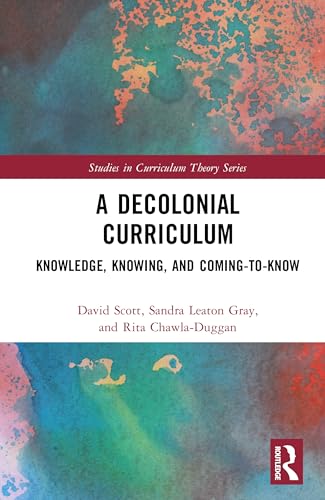
Studies in Curriculum Theory Series A Decolonial
Uitgelicht
|
176,00 |
Naar shop
|
|
179,68 |
Naar shop
|
|
179,68 |
Naar shop
|
Beschrijving
Bol
This book proposes twelve fundamental domains of human life - knowing, communicating, genealogising, positioning, cognising, understanding, enhancing, philosophising, acting in the world, valuing, embodying, and creating - as generative elements for curriculum design. A Decolonial Curriculum advances the claim that a decolonial and transcolonial curriculum must be grounded in a substantive account of what human beings do, have done and might yet do. It proposes 12 fundamental domains of human life - knowing, communicating, genealogising, positioning, cognising, understanding, enhancing, philosophising, acting in the world, valuing, embodying and creating - as generative elements for curriculum design. Taken together, these domains offer a non-reductive framework that resists the false dichotomy between ‘colonial’ epistemologies and ‘indigenous’ ways of knowing and being. Rather than opposing knowledge traditions, the book argues for a pedagogy that is dialogical, embodied and reflexive, while recognising the limits of decolonial critique alone. It therefore advances a transcolonial pedagogy oriented towards hybrid, relational and productive epistemic formations, capable of preparing learners for materially and historically interconnected futures. It is an essential read for academics, educators, policy-makers and anyone engaged in designing, developing and rethinking curriculum.
AmazonPages: 224, Edition: 1, Hardcover, Routledge
Prijshistorie
* Prijshistorie bevat geen data van Amazon, Amazon Marketplace.
Prijzen voor het laatst bijgewerkt op: